He Boasted of Cracking a Dalit Father’s Skull. He Called Modi and Ministers His ‘Elder Brothers.’ It Took a Podcast, Not the Police, to End His Freedom.
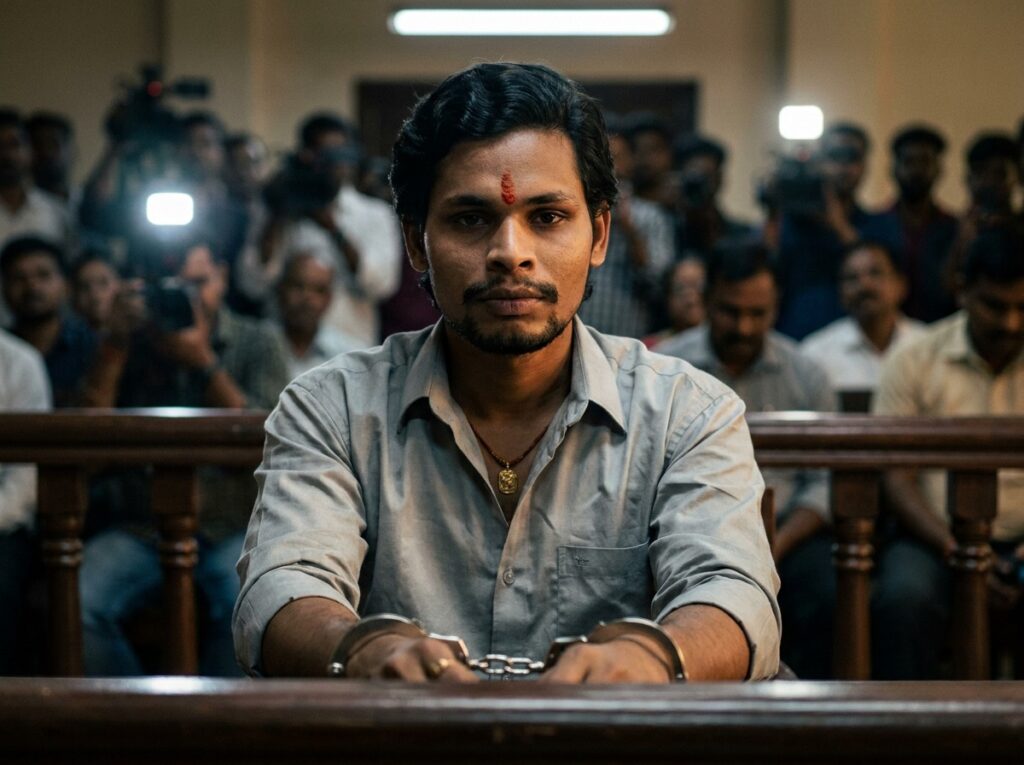
The man sat across from the interviewer, smiled, and described the night he got away with it.
“Nishu ke baap ka hum sar faade hain,” Swatantra Bharadwaj said. I cracked open the head of Nishu’s father.
“Do you know which section this crime attracts? Section 307. Half murder.”
He needed 60 stitches, Bharadwaj continued, calm as a man discussing the weather. The man was being taken away in an ambulance, in a condition to die. His daughter stood outside the police station saying she would kill herself if her father did not get justice.
“But I did not even go to jail. The world should know this. I was out and about through the night.”
Then the part that turned a confession into a political earthquake. He named his protectors, one by one, like a man reciting a list of credentials.
“Hanuman ji ka aashirwad hai,” he said. And then: Kapil Mishra is my elder brother. They say Kapil Mishra called and I was released. Chirag Paswan is my elder brother. Do you know Modi ji? Modi ji is also my elder brother. I have everyone’s support.
He was right about one thing. The world should know. And on Friday, September 4, the world did.
The boast went viral on X. The man was arrested the same day. But here is the line worth holding onto: Swatantra Bharadwaj, 21, spent 73 days free after the assault, and it was not a victim’s complaint, not a child’s tears, not an FIR that finally moved the state. It was his own arrogance, recorded, broadcast, and laughed at by the internet.
One afternoon, one viral clip, 73 days of nothing undone
The interview ran an hour. The clip that broke the internet ran under two minutes. It was clipped and shared from the podcast of Rowdy Rathore, and it detonated across X within hours.
The moment Bharadwaj brags about cracking a skull, calling it “half murder” and crediting his political “brothers” for his freedom, is the single most damaging self-own in Indian political media this year.
The response was immediate and furious. CJP supporters marched to Parliament Street police station. MPs Chandrashekhar Azad and Pappu Yadav joined them. And one by one, the country’s most powerful opposition voices began sharing the video.
Rahul Gandhi did not just condemn it. He replied directly to Nishu Azad, the 14-year-old whose father was attacked:
“Nishu, there is no need to panic. I am with you. It is clear that you have been targeted because you raise your voice for the rights of your community and students. Amit Shah’s Delhi Police, on one hand, commits inhuman barbarity against students. On the other hand, the criminal who split open the head of a Dalit girl’s father is roaming freely. @narendramodi ji, @AmitShah ji: why does such a criminal have the protection of you and your party’s people? Will there be action now, or will you keep shielding someone? Nishu, your fight is not alone. We will not stop until justice is served. Jai Bhim. Jai Samvidhan.”
The post drew tens of thousands of likes and millions of views within hours. Arvind Kejriwal shared the same video and demanded: “Did heroes like Bhagat Singh sacrifice their lives for this, that one day the country would get a prime minister who would openly protect such thugs?” Mahua Moitra demanded Amit Shah’s resignation. Pawan Khera mocked the idea of Bharadwaj as Modi’s “GenZ outreach ambassador.”
Delhi Police arrested Bharadwaj in Bulandshahr, Uttar Pradesh, the same Friday evening. He had reportedly fled his village on a Bullet motorcycle, helmet on, heading toward Khurja. Police teams caught up near Dhamra Nara village.
The audacity that freed him for 73 days is the same audacity that finally ended his freedom. His mouth, not the law, brought him down.
The boast that named the patrons
Here is what Bharadwaj actually said, because the politicians he named will never say it as clearly:
“I have the blessings of Hanuman upon me. And secondly, Kapil Mishra is my elder brother. They say Kapil Mishra called and I was released. Chirag Paswan is my elder brother. How many leaders do you know? Do you know Modi ji? Modi ji is also my elder brother. I have everyone’s support.”
Read it again. The man is not confessing to a crime. He is advertising his immunity.
He is telling the world that the machinery of protection is so ordinary, so expected, that a 21-year-old can name three national leaders as his “brothers” and assume everyone will believe him.
The geography matters. Kapil Mishra is a minister in Delhi, where the assault happened and where the police answer to the Centre. Chirag Paswan is a Union minister from Bihar, whose party is an ally of the BJP. Bharadwaj is from Uttar Pradesh. He picked the two states and the two ministries that would make his boast credible: Delhi and Bihar, police and patronage, the two poles of the government’s power.
And the boast worked, until it didn’t. For 73 days, no one in power moved to contradict him. The silence was the proof. A denial came only from Delhi Police, in a fact-check that read like a lawyer’s brief. But the named patrons themselves? Nothing.
Then the world weighed in, and the calculus changed. Chirag Paswan filed a complaint saying his name was misused. Kapil Mishra, as of this writing, has said nothing at all.
The man who named them as his “elder brothers” is in custody. The “brothers” are pretending they never met him. That silence, too, is evidence.
The 73 days before anyone moved
Here is the date worth remembering: June 23.
That is when Delhi Police say Sanjay Kumar, 38, a resident of Ghaziabad, was hit on the head with a kada, an iron bracelet, during a CJP protest at Jantar Mantar.
Notice how many reports you will read today that say July 20. The confusion is itself a symptom. A story this serious could not hold its own date straight for 73 days, because for 73 days the story was not moving anyone.
The sequence, per police: Sanjay filed a complaint. An FIR was registered at Parliament Street police station under the Bharatiya Nyaya Sanhita. Two men, Suraj Kumar, 24, and Bharadwaj, 21, were detained at the site, questioned, served notices, and let go.
Bharadwaj, police add, filed his own complaint about a minor injury he suffered in the scuffle. A chargesheet, police said, would come soon.
The word police used was scuffle. The word Bharadwaj used, on the podcast, was skull.
A father, a schoolgirl, and a family that stopped calling itself Hindu
Sanjay’s daughter was no bystander. Nishu Azad, 14, a Dalit content creator, had been part of the CJP’s education protests from the start. CJP leaders say she has been with the movement from day one. Her father accompanied her everywhere.
Months earlier, the two of them had issued a joint statement declaring their socio-religious separation from Hinduism. They said they did not identify as Hindu. They said they followed Ambedkar.
That statement went viral in the wrong way. Conservative accounts turned on the family.
The Mooknayak, which first reported the family’s ordeal in July, described the father being ambushed on June 23 by a group of about 15 men while he recorded footage at the protest. One attacker struck his camera, then rained blows with a kada. The head, the report said, split in three places and needed emergency stitches.
Then came the threats aimed at the child. Rape threats. Acid threats. Murder threats. Mocking reels.
In a tearful video on June 30, Nishu appealed to Delhi Police and the Delhi Commission for Women. “I am not scared, but I am going into trauma,” she said. “Is showing the truth a crime? How many FIRs should I file?”
She filed one over the online harassment. She kept appearing in public anyway.
She is a minor, which is why CJP leaders now want the POCSO Act applied to the threats against her. She told reporters she was ashamed to go outside, that she felt everyone was judging her, that she hoped police would act.
The police version, and the questions it raises
Delhi Police have a position, and it deserves a fair hearing.
On Thursday evening, the force posted a fact-check. Sanjay Kumar’s injuries, per the medico-legal case report from RML Hospital, were “simple in nature.” They were caused by a kada, not a weapon. The claim of a cracked skull was, in the police’s words, “completely baseless” misinformation.
If that is true, it explains why officers treated June 23 as a scuffle and served notices instead of handcuffs. Attempt to murder under Section 307 needs more than a viral boast. It needs medical and forensic corroboration.
Fair enough. But the questions do not stop there.
Why did the SC/ST Act have to wait for a protest march to be added, when the victim’s family is Dalit and CJP says caste abuse was part of the pattern? Because, CJP says, police told them to approach the court and get an order. Why did the family have to drag MPs to a police station to obtain a promise of arrest within 72 hours, a promise that is a political commitment, not a legal timeline?
And why did a fresh medical examination happen only after the cameras arrived? A police source told PTI that with the SC/ST Act now added, the victim will undergo another examination. Only then will police decide whether attempt to murder applies.
Which is another way of saying: for 73 days, no one thought the head of a Dalit father at a student protest deserved a second look.
The influencer’s retreat
Bharadwaj, once caught, performed a textbook pivot.
The clip was fake, he said. He was joking. “I am a social media influencer,” he told NDTV, “so what I said was said in a joking manner.” Kapil Mishra and Chirag Paswan are like brothers, he explained. People should understand sarcasm.
The self-defence story came next. He was surrounded by 10 to 15 people at Jantar Mantar, he claimed. He was on the verge of being lynched. He struck out with his kada because he had no choice. He has video proof, he says. The injuries were minor, he says, citing the same police medical report.
Then came the line that undid the whole defence.
Asked whether he regretted it, Bharadwaj told NDTV he would do it again. “If I am cornered like that again and attempts are made to target me, I will strike with my kada once more.”
No remorse. No hesitation. Just the grammar of a man who treats violence as content and retraction as banter.
The brotherhood nobody will claim
Here is the part that should worry every party.
Bharadwaj’s boast named names. Kapil Mishra called and I was released, he said. The world should know, he said.
Delhi Police deny it. Any allegation of undue influence is “factually incorrect and baseless.”
But a denial is not an inquiry. Nobody has explained why a 21-year-old would invent a minister’s phone call as his alibi for freedom, unless he believed the audience would find it plausible. Either a minister interfered, or the boast only worked because everyone assumes such calls happen. Every version indicts someone.
Chirag Paswan chose a different route. He filed a formal complaint, saying Bharadwaj had misused his name, and asked Delhi Police to investigate fairly. That is a politician running for cover with paperwork. Kapil Mishra has chosen silence.
The CJP is demanding that senior BJP leaders clarify. The silence is the story.
The mirror the state should look into
Set this against the summer that preceded it.
In May, Chief Justice Surya Kant likened young Indians without jobs to cockroaches, and a movement was born from the insult. The Cockroach Janta Party grew into one of the largest protest movements India has seen online, forcing the resignation of the Union education minister in July after the NEET-UG paper leak and the mass retest of 2.2 million candidates.
On July 20, police cleared a peaceful march from Jantar Mantar toward Parliament with tear gas and batons. The state registered FIRs against protesters by the hundred, across at least five states.
On September 1, the Supreme Court used its extraordinary Article 142 powers to quash those FIRs, at the request of the Centre, with one carve-out: protesters with criminal antecedents stay booked. Delhi Police had told the court in August that history-sheeters had infiltrated the protests. The CJP called off its planned September 5 march in relief.
Three days later, the man who boasted about cracking a protester’s father’s head was detained.
Read the two files side by side.
The state could find hundreds of students, name them, book them, and hold them in its paperwork for months. It could not find the 21-year-old who bragged about the kada until a podcast made him famous.
Protesters got FIRs. The man who attacked a protester’s family got a notice. A Dalit schoolgirl got rape threats and had to beg for an FIR. A self-described “Sanatani Yoddha” with 1.84 lakh Instagram followers got an audience.
Whose head does this state crack down on, and whose head does it let heal?
What the 73 days really exposed
Strip away the outrage and three uncomfortable truths remain.
First, justice in India now runs on virality. The FIR sat. The medical report sat. The schoolgirl’s trauma sat. One two-minute clip, amplified by opposition politicians and a movement with tens of millions of online followers, moved the machinery in under 24 hours. That is not justice. That is a lottery. And the losers of that lottery are the victims who cannot trend.
Second, the shame is inverted. The girl whose father was attacked, who was threatened with rape and acid, is the one who stopped going to school. She is the one who feels judged. The man who swung the kada and bragged about it walked through the night, made podcasts, and posted status updates. That inversion is not incidental. It is the whole point of the violence.
Third, the kada was never just a weapon. It is a symbol worn by millions of Hindu men. Bharadwaj chose it, or reached for it, against a Dalit man whose public act of defiance was to say he no longer identifies as Hindu. The family says the attack was retaliation for that statement. The caste dimension was not a demand CJP invented on Friday. It was in the family’s first appeal in June, and it took the SC/ST Act being added only after a march to make it official.
The open questions
Bharadwaj was in custody as of Friday night, detained in Bulandshahr. Formal arrest, remand, and chargesheet will now follow the script.
The deeper questions will outlast this news cycle. Will the fresh medical examination find what the first one missed? Will attempt to murder stick, or will the papers call it a scuffle again? Will the POCSO FIR over threats to a minor name real accounts and end with real arrests? Will Kapil Mishra ever answer PTI’s call? Will Chirag Paswan’s complaint lead anywhere but a filing cabinet? Will any BJP leader explain the “elder brother” boast, or will silence simply become the accepted answer?
And when the outrage cools, when the reels move on to the next horror, and the cameras leave Parliament Street, watch what happens to the next Sanjay Kumar and the next Nishu.
The system just showed us what it takes to move it. A victim’s complaint was not enough. A child’s tears were not enough. It took a confession, made in arrogance, broadcast for clout, to finally get the state to act.
That is not a victory for justice. That is an indictment of everything that came before it.
Sources
- Viral podcast clip of Swatantra Bharadwaj, as circulated on X: https://x.com/BharatEkNaiSoch/status/2095391080762245572; full interview with Rowdy Rathore on YouTube
- Rahul Gandhi’s reply to Nishu Azad, September 3, 2026: https://x.com/RahulGandhi/status/2095512261058330941
- Chirag Paswan’s statement on misuse of his name, via IANS: https://x.com/ians_india/status/2095837651828080705
- ANI: Bharadwaj calls the clip fake and claims self-defence: https://x.com/ANI/status/2095763200600072526
- Delhi Police fact-check statement of September 3, 2026, quoted via ANI and NDTV
- PTI reports of September 4, 2026, as carried by The Times of India, Rediff and National Herald
- NDTV interview with Swatantra Bharadwaj, September 4, 2026
- Hindustan Times reporting and CJP protest live blog, September 4, 2026
- News18 and Siasat Daily reports on the Bulandshahr detention, September 4, 2026
- The Mooknayak, “14-Year-Old Dalit Content Creator Gets Open Rape Threats,” July 1, 2026
- ETV Bharat, CJP accusation against Delhi Police, September 3, 2026
- Supreme Court order of September 1, 2026, quashing FIRs against CJP protesters, as reported by The Indian Express, NDTV and The Tribune
- Earlier CJP coverage: Al Jazeera, The Hindu, BBC (July 2026)