Locked for 250 years: iPhone 17 Pro Max, Lincoln’s 3D hand, and 200 artifacts buried in a steel vault beneath Philadelphia
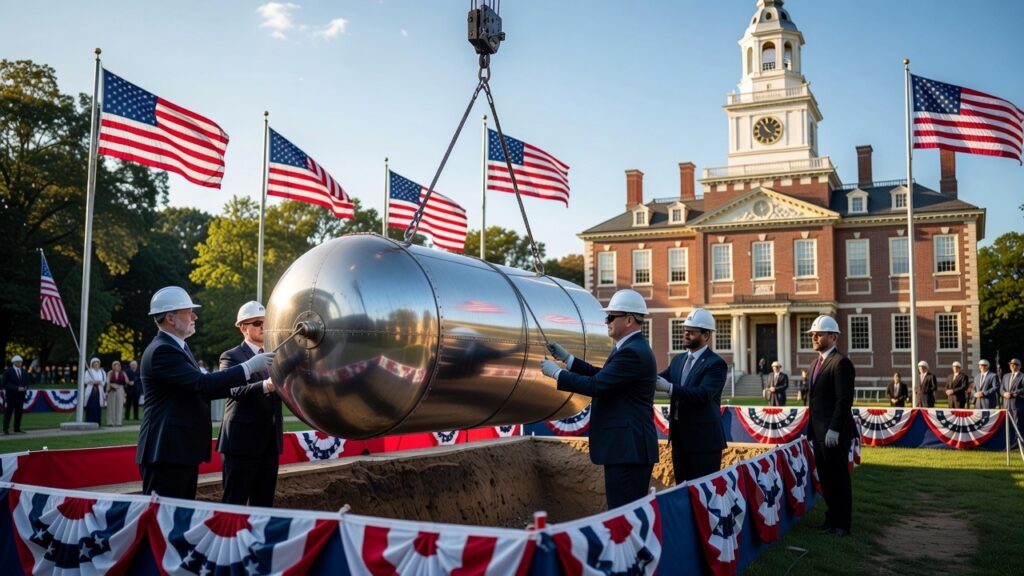
On July 4, 2026, a 900-pound stainless steel cylinder sank ten feet into the ground at Independence National Historical Park in Philadelphia. It won’t see daylight again until July 4, 2276.

Inside that cylinder lies a cross-section of American life in 2026. A Cosmic Orange iPhone 17 Pro Max, donated by Apple as a symbol of technological innovation. A 3D rendering of Abraham Lincoln’s hand. A bone from an endangered North Atlantic right whale, sent by Maine. An Arkansas diamond. An AI-generated prediction from California’s governor that the state will secede and join a “Pacific Federation” by 2276. And synthetic DNA encoded with digital copies of Thomas Jefferson’s rough draft of the Declaration of Independence.
Those 200-plus artifacts are sealed inside “America’s Time Capsule,” the centerpiece of the nation’s semiquincentennial celebrations.
The capsule was mandated by a 2016 law that created the nonpartisan America250 commission. A time capsule was to be buried in Philadelphia on the 250th anniversary of the Declaration of Independence and dug up exactly 250 years later.
A 900-pound steel vault designed to outlast centuries
The National Institute of Standards and Technology got the job of building a container that can survive 250 years underground. Michael Berilla, who directs NIST’s fabrication technology office, led the team that built it.
“Once it was closed, it was a little bit anticlimactic, and then it was kind of really emotional,” Berilla said.
The cylinder is made of stainless steel. It’s cylindrical rather than box-shaped because square edges tend to crack and break over time. A secondary outer cylinder traps air and pushes away any approaching water. The capsule itself is rimmed with a soft metal that compresses under pressure when the lid is sealed shut.
“When you smash it shut with the lid, that metal goes into all the cracks and spaces and makes an airtight, watertight seal,” Berilla told the Associated Press.
The items inside were stored at 35% relative humidity.
A number that matters. Moist enough to prevent the contents from drying out and disintegrating. Dry enough to avoid moisture problems. The capsule sits ten feet underground, safe from temperature fluctuations and storm damage.
“Philadelphia would have to be six feet underwater in order for this time capsule to even possibly take on water,” Berilla said. “And if Philly is six feet underwater, you have way bigger problems in the world.”
What went inside: 200 artifacts from every state
The collection includes contributions from all 50 states, five US territories, Washington DC, and all three branches of the federal government. Private partners including Apple, Coca-Cola, the Smithsonian Institution, and the International Olympic Committee also donated items.
Among the most striking entries is a molecular data storage device from the Library of Congress. This tiny metal vial contains synthetic DNA encoded with digital copies of historic collection items: Jefferson’s rough draft of the Declaration of Independence, Francis Scott Key’s handwritten lyrics for “The Star-Spangled Banner,” an 1898 audio recording of the anthem by John Philip Sousa’s band, and a 3D rendering of Lincoln’s hand.
Apple contributed an iPhone 17 Pro Max in Cosmic Orange, loaded with “digital artifacts” in its Notes app for future generations to explore. Will it work after 250 years? Probably not. The battery will almost certainly degrade beyond use. But as a preserved artifact of early 21st-century technology, it represents a moment when pocket-sized slabs of glass and metal had become how humanity checked the weather, called home, and read the news.
The other partner items are equally curated for historical resonance. Coca-Cola contributed a glass bottle alongside the lyric sheet for “I’d Like to Buy the World a Coke.” The IOC and NBC donated a gold medal from the Cortina Olympics. The Supreme Court justices signed a pocket-sized copy of the Constitution.
From whale bones to AI predictions: what each state sent
Every state and territory sent something. The instructions were simple: nothing that would rust, degrade, or decompose. Maryland’s attempt to include Old Bay seasoning was rejected.
Some submissions are deeply personal. Delaware sent twelve notecards with residents completing the prompt, “To me, Delaware is…” West Virginia contributed an essay by a high school student who won a writing contest. Utah sent 100 cards featuring different historical figures who shaped the state.
Others look forward. California included an answer it received when it asked an AI chatbot to predict the state’s future 250 years from now. The prediction: highways will disappear, grizzly bears will return, and the state will secede to join Oregon, Washington, and British Columbia in a new “Pacific Federation.”
Arizona used nano-etching technology to inscribe the full text of the Declaration of Independence and the Constitution onto a single stainless steel coin. Ohio contributed a piece of fabric from the wing of the Wright Brothers’ 1903 aircraft. Wisconsin sent a feather from a bald eagle that accompanied a Wisconsin infantry unit during the Civil War.
The variety of submissions fascinated Tom Medema, a retired National Park Service official who served as project manager for the time capsule.
“I’m glad there was not really a prescription for it,” Medema said. “I know that was hard for them, but in the end, it was just up to them to represent themselves.”
He noted that some items reflect darker periods of American history and the nation’s current challenges. But despite this, a sense of optimism pervaded the project.
“There’s great hope in what this capsule represents and the messages that are put in it,” he said. “Something about this capsule has been truly uplifting for everyone who has been involved in it.”
Rosie Rios, chair of the America250 commission, described the capsule as a bridge between centuries.
“This moment is as much about the future as it is the past,” Rios said. “When it is opened in 2276, future generations will see the care, pride, and optimism with which Americans marked our 250th anniversary.”
A tradition of sending messages across centuries
This is not the first such capsule tied to the signing of the Declaration of Independence. A “Century Safe” filled in 1876 was opened by President Gerald Ford in 1976. An official Bicentennial time capsule, created that same year, is stored at the National Archives and will be opened in 2076. Another capsule is in development for the US Capitol Visitor Center.
To ensure the capsule is actually found in 2276, the National Park Service has embedded details about it in its succession plans, designed to be passed down through generations of park officials. A capstone marking the burial spot will also identify the site.
Berilla’s team included a photograph of themselves inside the capsule, along with a letter he wrote on their behalf.
“Greetings from the living, breathing hearts and hands of 2026,” Berilla wrote. “We will have long since returned to dust, but our devotion, pride, and unwavering hope for what our world could become are alive right here inside this steel. We built this for you.”
The capsule sits beneath Philadelphia soil. In 250 years, someone will dig it up and find an iPhone, a whale bone, a diamond, a letter from a machine about the future, and the hopes of a nation frozen in stainless steel.