Your Car on Ethanol: The ₹1.4 Lakh Crore Experiment No One Asked For
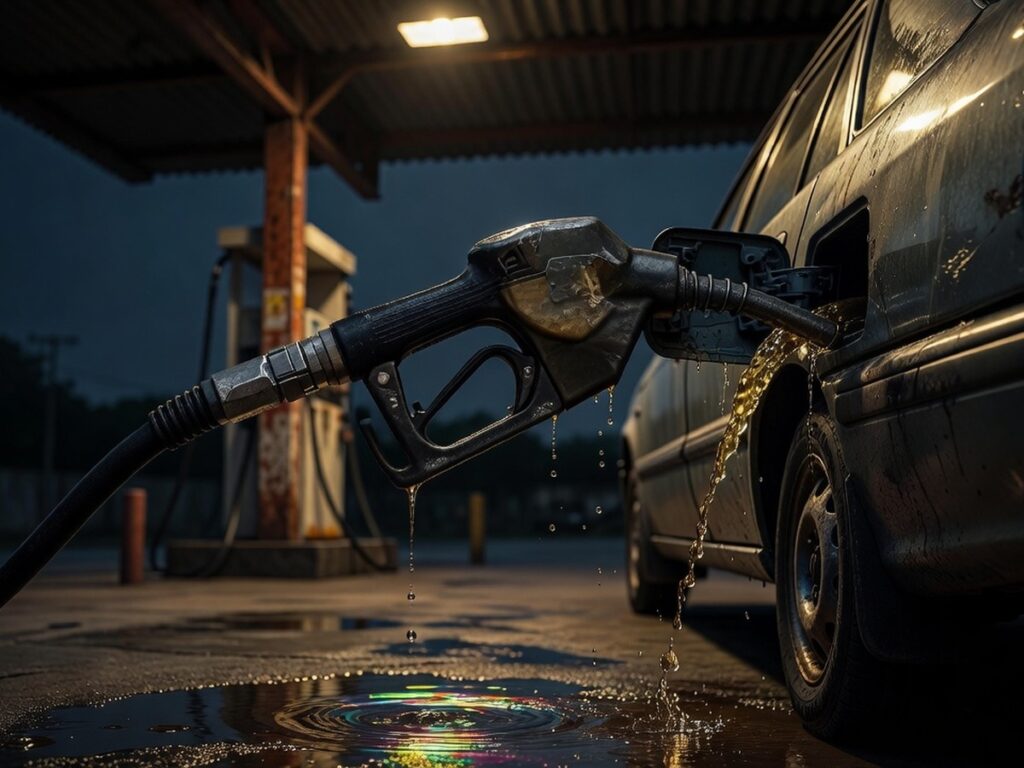
New Delhi: On a sweltering afternoon in July, Rajeev Nair pulled his 2019 Honda City into a petrol pump in Noida, swiped his card, and watched the display tick over. He noticed the pump had a new sticker: “Now dispensing E20 petrol.” He didn’t think much of it — until his car started doing 11 kilometres per litre instead of the 15 it had managed for six years.
He is not alone. Across India, millions of vehicle owners have watched their mileage drop since the government mandated 20% ethanol blending in petrol. What began as a climate policy has become one of the most widespread consumer disputes to reach the Supreme Court in recent memory.

The Mandate
India’s E20 policy — requiring all petrol sold in the country to contain 20% ethanol — was rolled out nationally in 2025-26, following a roadmap prepared by NITI Aayog in 2021. The policy’s stated goals are unobjectionable: reduce oil import dependence, support sugarcane farmers, and cut vehicular carbon emissions.
The government claims it has saved over ₹1.4 lakh crore in foreign exchange since 2014 through ethanol blending. Petroleum Minister Hardeep Singh Puri has described the efficiency loss as a “minor drop,” arguing that better acceleration and engine performance offset the mileage reduction.
But for millions of drivers who never asked to be part of this experiment, the trade-off does not feel minor.
The Experiment That Wasn’t Supposed to Be Called One
In late June, the government found itself in an unexpected position: defending its own policy in the Supreme Court. And then it got worse.
The government’s lawyer, senior advocate R. Venkataramani, told the court that E20 was an “experiment” whose results would only be known next year. The word hung in the air. If the government itself was calling its nationwide fuel policy an experiment — one whose outcome was uncertain — on what basis had it forced 300 million vehicle owners to participate?
Within hours, the Ministry of Petroleum issued a denial. The “experiment” remark, it said, had been misreported. No clarification was offered on what alternative word Venkataramani had actually used.
The Supreme Court has allowed the rollout to continue for now, but the case remains open.
The Mileage Math
The government’s own data tells a complicated story.
Studies conducted by Indian Oil, the Automotive Research Association of India (ARAI), and the Society of Indian Automobile Manufacturers (SIAM) found a 3-6% drop in fuel efficiency with E20. These studies have never been made public in full.
The real-world numbers are starker. A LocalCircles survey of over 50,000 respondents found that 8 out of 10 owners of older petrol vehicles reported a measurable drop in mileage after the E20 mandate. On Reddit’s r/carIndia, owners report efficiency falling from 13-14 kmpl to 10-11 kmpl — a loss of over 20%.
The reason is straightforward: most vehicles sold in India over the last 15 years were engineered for E5 (5% ethanol) or E10 (10% ethanol). Ethanol has lower energy density than petrol. More ethanol means more fuel burned to travel the same distance. The physics is not disputed. What is disputed is whether the government adequately communicated this to consumers before making E20 mandatory.
Nitin Gadkari, the Road Transport Minister, threw an open challenge: show him one vehicle in the world that has had problems because of E20. The challenge went viral. Several users responded with photographs of engine warning lights, fuel system repairs, and service bills. None of them received a reply.
The Car That Wasn’t Designed for This
Most Indian cars manufactured before 2023 were not designed for E20 fuel. Ethanol is corrosive to rubber seals, plastic components, and certain metal alloys used in older fuel systems. While automakers have begun producing E20-compatible vehicles, the average age of a car on Indian roads is over eight years.
For a family that bought a car in 2018, expecting it to last a decade, the E20 mandate means their vehicle’s fuel system components — fuel pumps, injectors, seals — may degrade faster than designed. The repair bills, when they come, will be theirs to pay.
The government has dismissed claims of vehicle damage and insurance complications as misleading. Gadkari has publicly stated that no vehicle has been damaged. But the Ministry has not offered a compensation mechanism for owners who can demonstrate reduced mileage or accelerated wear.
The Bigger Picture — E100 on the Horizon
The E20 mandate is not the end point. Petroleum Minister Puri has already signalled that the government is preparing for E100 — 100% ethanol fuel. The Minister described better acceleration as a “key benefit” that offsets the mileage loss.
No timeline has been given for E100. But the direction is clear: India’s fuel future is increasingly ethanol-based, and the transition is being driven from the top, not by consumer demand.
The Sugarcane Equation
Behind the policy lies a less discussed economic logic. India produces more sugarcane than its sugar market can absorb. Ethanol production absorbs surplus cane, supports farmer prices, and reduces the government’s subsidy burden. In 2024-25, ethanol production consumed over 40 lakh tonnes of sugar — effectively preventing a glut that would have crashed domestic sugar prices.
The policy benefits a powerful political constituency: sugarcane farmers in Uttar Pradesh, Maharashtra, and Karnataka. The E20 mandate converts an agricultural surplus problem into an energy policy. Whether it also converts smoothly into consumer acceptance is another question.
The Trust Deficit
The E20 controversy is not just about mileage or ethanol. It is about a deeper pattern: a government that mandates first and explains later.
Consumers were not consulted before the rollout. The studies showing efficiency loss were not released. The “experiment” remark was made and then denied. When citizens asked questions, a minister challenged them to prove their car was damaged — shifting the burden of proof onto the individual.
This approach may work for a policy with clear winners. But the E20 mandate creates a clear class of losers: the millions of Indians who drive older vehicles, who cannot afford a new car, and who now pay more per kilometre for a policy they never voted on.
The Unanswered Question
The Supreme Court will hear the case again. The government will defend its policy. The studies will eventually be released — or not. Drivers will keep filling their tanks, watching the kilometres shrink, and wondering who asked them.
The question that remains — and that no one in power has answered — is simple:
If E20 is such a good idea, why wasn’t anyone given a choice?