Telegram Banned, WhatsApp Spared — Same NEET Leak Threat, Why One App Got Blocked
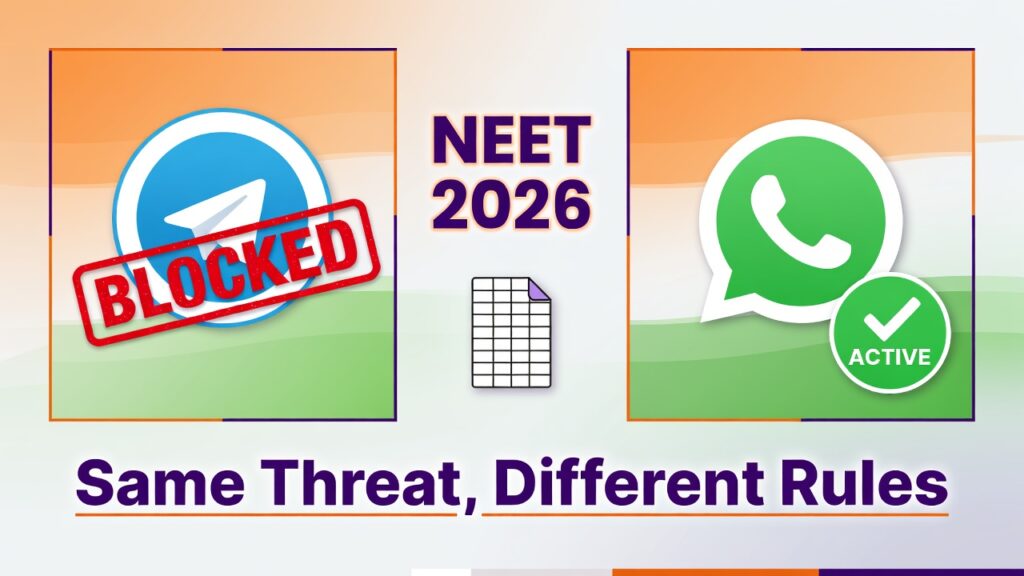
On June 16, the Ministry of Electronics and Information Technology (MeitY) ordered telecom operators to block Telegram across India until June 22. The trigger: the NEET (UG) 2026 re-examination scheduled for June 21. The stated reason: organised cheating rackets using Telegram to defraud candidates with fake paper leaks and misinformation campaigns.
But here’s the question nobody in the government is answering: why Telegram and not WhatsApp?
What Actually Happened
MeitY invoked Section 69A of the Information Technology Act, 2000 — the same provision used to block Chinese apps and platforms accused of threatening national security. The order restricts access to Telegram until June 22, covering the re-exam day and its “immediate aftermath.”
A separate directive requires Telegram to disable its message-editing feature in India until June 30. The NTA argued that fraudsters were exploiting Telegram’s timestamp-preserving edit feature — posting an old message before an exam, then inserting the real question paper afterward and circulating screenshots as fake evidence of a leak.
The National Testing Agency (NTA) welcomed the move, calling it a “calibrated and bounded” measure taken “in the interest of public order.”
The Ground Reality — Not a Clean Block
On the ground, the block is patchy. Telegram shows “Connecting” on several Indian ISPs but doesn’t load messages on many networks — while on some connections, basic messaging still trickles through. The government’s initial messaging suggested that regular person-to-person chats would remain functional while only channels and the edit feature would be restricted. The actual implementation turned out to be a broader access block that is inconsistently enforced across different ISPs.
This uneven rollout has left millions of users confused — unsure whether their app is broken or banned.
The Edit Exploit That Triggered It All
The NTA’s detailed explanation zeroed in on one specific Telegram feature: when a channel admin edits a message, the platform retains the original timestamp while marking it as edited. Admins can also replace attached files — including PDFs — after publication.
Here’s how the exploit worked:
- A channel posts a harmless message days before the exam
- After the exam concludes, the admin edits that same message, replacing the content with the actual question paper
- The message now appears — to anyone checking — to have been posted before the exam, because Telegram kept the original date
- Screenshots circulate as “proof” of a paper leak, fuelling panic among students and families
- Scammers demand money — from a few thousand to several lakh rupees — from anxious candidates
It’s a clever, platform-specific exploit — and one that only Telegram’s architecture enables.
Why Telegram and Not WhatsApp?
The government’s argument comes down to three structural differences between the two platforms:
1. Public Channels vs. Private Conversations
Telegram channels are broadcast powerhouses — public, searchable, joinable by anyone, capable of reaching hundreds of thousands of subscribers instantly. WhatsApp is fundamentally a private messaging platform where every group requires an invite tied to a phone number. An organised cheating syndicate can set up a Telegram channel with 500,000 subscribers in minutes. Doing the same on WhatsApp is practically impossible at scale.
2. Anonymity
Telegram allows anonymous or pseudonymous channel administration — no phone number required to run a channel with millions of followers. WhatsApp accounts are tied to verified phone numbers, creating a paper trail that investigators can follow.
3. Message Editing with Frozen Timestamps
WhatsApp’s limited “edit message” feature (introduced in 2024) updates the timestamp to show when the edit happened. It also restricts editing to within 15 minutes and doesn’t allow file replacement. Telegram’s unrestricted editing with original timestamps is what made the fake leak fabrication possible — and what triggered the government’s second directive.
The Elephant in the Room — WhatsApp’s 750 Million Users
None of this fully explains why the government chose to block an entire platform rather than target specific abusive channels — especially when the same cheating threats exist on WhatsApp, which is far more deeply embedded in India’s digital fabric.
The honest answer may be simpler: WhatsApp has 750 million users in India. Telegram has an estimated 150-200 million. Blocking WhatsApp would paralyse business communication, healthcare coordination, education, journalism, and UPI-based payments for half a billion people. The economic and political cost would be catastrophic.
Telegram’s 150 million users matter, but they don’t hold India’s digital economy hostage. The government took a calculated risk: inconvenience millions of Telegram users for a week rather than touch the platform that India’s economy runs on.
It’s a double standard — but an honest one.
Durov’s Response
Telegram founder Pavel Durov criticised the ban on X, calling it a misplaced punishment:
“It punishes 150M+ ordinary Telegram users in India — not the insiders who leaked the exam materials. And the ban hasn’t stopped anything. The leaks just moved to other apps.”
Durov has a point. Hours after the block was imposed, reports emerged of cheating networks migrating to Discord, WhatsApp groups, and encrypted messaging platforms that India cannot easily block. The root cause — weak exam security and a broken trust in the NTA’s ability to conduct fair exams — remains entirely unaddressed.
What This Means for the Future
The Telegram block sets a troubling precedent. Section 69A was designed to block content — not entire platforms. The Internet Freedom Foundation (IFF) has already questioned whether the law permits “a national block of a messaging app” as a proportionate response to fraud that could have been tackled through targeted account removal and law enforcement action.
If the government can block Telegram for a week over exam cheating, what stops them from doing the same to any platform — including WhatsApp — the next time a national exam or event faces a security scare?
The answer, for now, is that WhatsApp is too big to block. But that’s not a principle — it’s a pragmatic calculation. And pragmatic calculations can change.
For the millions of Telegram users in India who woke up to a “Connecting” screen that never resolves, the message is clear: you are collateral damage in a fight the government chose not to have with a bigger opponent.
Timeline of Events
- May 3 — NEET-UG 2026 conducted; paper leak allegations emerge
- May 12 — NEET-UG cancelled, CBI investigation ordered; 2.2 million students affected
- June 16 — MeitY orders Telegram block until June 22; edit feature disabled until June 30
- June 21 — NEET-UG 2026 re-examination scheduled
- June 22 — Telegram access expected to be restored
(This article was updated with ground reports of the block’s inconsistent enforcement across Indian ISPs.)